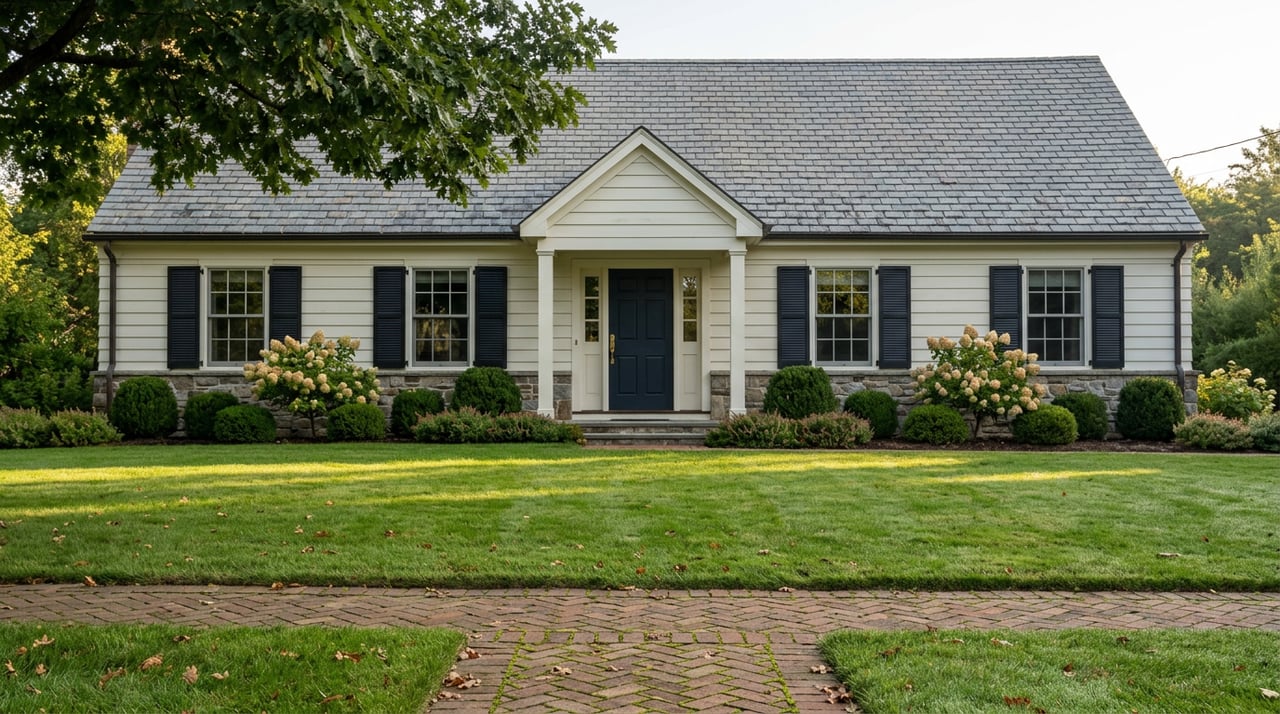
A buyer walks into a closing on a Milton Point colonial in the City of Rye and learns, three weeks before the wire, that the lender wants a flood policy in force at signing. The National Flood Insurance Program has a 30-day waiting period from application. The exception that saves the closing exists, but only because the policy is tied to the loan itself. That is the kind of detail that separates a smooth transaction in Rye from a scrambled one, and it only applies to one of the three markets the search portals lump under the word "Rye."
If you have been comparing Westchester towns from a laptop, you have almost certainly seen a single median attached to "Rye, NY." That number is doing more hiding than showing. The address bar says Rye. The tax bill, the school district, the flood map, and the price band underneath it may belong to somewhere else entirely.
One name, three municipalities, one accident of 1942
The Village of Rye was granted city status in 1942, and because New York State treats cities and towns as equal political entities, the City of Rye then became independent of the Town of Rye. What was left of the Town, which still exists today, is a noncontiguous municipality made up of the Village of Port Chester, the Village of Rye Brook, and the Rye Neck section of the Village of Mamaroneck. Rye Neck does not touch either Port Chester or Rye Brook. The City of Rye sits in between them, geographically and financially.
That history is why a listing described as being "in Rye" can mean any of the following, each with its own school district, its own village or city hall, and its own price behavior:
| Submarket | ZIP anchor | School district | Recent price signal |
|---|---|---|---|
| City of Rye | 10580 | Rye City | Median list $2.59M, July 2026 |
| Village of Rye Brook | 10573 | Blind Brook-Rye or Byram Hills | Zillow ZHVI near $996K, mid-2026 |
| Rye Neck (Village of Mamaroneck) | 10543 | Rye Neck UFSD | Median sale about $1.0M, recent Redfin |
The Rye City School District is not the same district as Rye Neck, and Rye Neck High School's campus is partially located inside the City of Rye limits, which is exactly the kind of boundary quirk that makes portal searches unreliable when school-district fit matters to a buyer.
Where the money actually goes
Portal medians for the City of Rye have hovered in the low-$2M range through 2026, with Movoto pricing the July 2026 list median at $2.59M and roughly $718 per square foot, and Redfin reporting a March 2026 sale median of $2.2M on thin monthly volume. Zillow's home value index for the 10580 ZIP sat near $1.89M as of mid-2026. Those numbers reflect what "Rye" means when a national portal draws a boundary around the City, and they explain the local shorthand that anything under about $2M in the City tends to be a co-op, condo, or townhouse rather than a detached house.
Cross into Rye Brook and the comparison shifts entirely. Zillow's Rye Brook home value index sat near $996K in mid-2026, and Redfin's small-sample March 2026 sale median came in around $645K, well below the City's figure. Rye Brook is a Village of about 9,300 people organized only in 1982, sitting inland along the Connecticut border with I-684 and the Hutchinson River Parkway defining its northern edge. Its park anchor is Crawford Park, not Playland. The housing stock skews later and less coastal, which is a large part of why the price band separates from the City by seven figures at the median.
Rye Neck is different again. The Redfin neighborhood file put the median sale near $1.0M with a median of about 16 days on market. The building stock includes pre-war co-ops such as Hawthorne Gardens and Evelyn Court, walkable two-family colonials near Harbor Island Park, and single-family homes within a short walk of Mamaroneck Station, which changes the commute math against both the City and Rye Brook. It is a Village of Mamaroneck address, a Town of Rye jurisdiction, and a Rye Neck school district enrollment, which is three different answers to what look like one question.
The friction the portals do not show
The City of Rye is the coastal one, and coastal here is not decorative language. Milton Point, historically known as Clamtown, sits on Long Island Sound. Rye Town Park and Oakland Beach are on the National Register of Historic Places and sit along Forest Avenue in the City. Playland is next door. Coastal exposure means FEMA Special Flood Hazard Areas, which means lender-mandated flood insurance for properties that fall inside them, which in turn means an elevation certificate becomes a document that shapes the offer, the appraisal, and sometimes the price itself.
Two closing-timeline facts every buyer inside the City of Rye's flood zones should know before writing an offer:
- Standard National Flood Insurance Program policies carry a 30-day waiting period from application. The exception is that when the initial purchase is tied to a mortgage loan, coverage becomes effective at closing provided the application and premium are complete. That exception is what makes a compressed timeline possible, and it is also what makes late-arriving elevation certificates so dangerous.
- FEMA rate maps are historical. About a quarter of NFIP claims come from outside high-risk zones. Rye's retired Judge Joe Latwin, writing in a January 2026 MyRye.com column, put it plainly: the $250,000 structure and $100,000 contents cap on an NFIP policy is not going to make a Long Island Sound homeowner whole. Private excess flood coverage exists for a reason, and it is worth pricing during due diligence rather than after inspection.
Rye Brook's exposure is different. The Village has less direct tidal frontage, and Redfin's environmental data flagged 18% of Rye Brook properties as having some risk of severe flooding over 30 years, versus Rye Neck's 28%. That is not a reason to skip flood diligence in the inland submarkets. It is a reason to price the diligence proportionately. In the Blind Brook watershed running south through the City, storm-driven inland flooding has a separate history from Sound-side tidal risk, and the elevation certificate on a Rye Brook parcel near Blind Brook can matter as much as on a City parcel two blocks from the water.
Reading a listing correctly
A buyer who wants to use these three submarkets rather than be confused by them can compress the diligence into a short checklist that survives contact with a real listing:
- Confirm the taxing municipality. The Town of Rye's Receiver of Taxes collects for Port Chester, Rye Brook, and Rye Neck. The City of Rye collects its own. A "Rye, NY" listing that pays taxes to the Town is not a City of Rye property.
- Confirm the school district by parcel, not by address. Two Rye addresses can attend two different districts, and a Rye Neck High School enrollment can coexist with a City of Rye mailing address.
- Pull the FEMA flood-zone designation before making the offer, not before the appraisal. If the parcel sits in an A, AE, V, or VE zone and the mortgage is federally backed, flood insurance is not optional.
- Ask for the elevation certificate on any City of Rye or Rye Neck property within a half mile of the Sound. Without it, the rating on the flood policy can be wrong in either direction, and the wrong direction almost always shows up during the lender's insurance review.
The mechanism underneath the price gap between these three markets is not mystical. It is the accumulated effect of a 1942 charter change, a 1982 village incorporation, three separate school districts, and a coastline that stops at the City of Rye. The portal median cannot see any of that. It can only average across it.
FAQ
Is a home in Rye Brook considered "Rye" for tax and school purposes? No. Rye Brook is a village inside the Town of Rye, taxed by the Town's Receiver of Taxes, and served by either the Blind Brook-Rye or Byram Hills school district depending on the parcel. The City of Rye is a separate municipality with its own tax collector and its own school district.
Why does the City of Rye's price band sit so far above Rye Brook's? The City has direct Long Island Sound frontage, a compact and largely built-out inventory, and a housing stock skewed toward detached single-family homes. Rye Brook incorporated in 1982, sits inland, and includes more townhouse and condominium inventory. The gap is a composition difference, not a straight quality gradient.
How early should a buyer arrange flood coverage on a City of Rye waterfront purchase? As soon as the parcel's flood zone is confirmed. The NFIP's 30-day waiting period does not apply when the policy is bound in connection with a loan closing, but any delay in producing an elevation certificate or in the private-market quote can compress the timeline enough to threaten the closing date.
If you are weighing offers across the City of Rye, Rye Brook, and Rye Neck, or trying to figure out which submarket answers the question you are actually asking, Khuzama DaCosta is available for a complimentary consultation. Schedule a conversation and we will map the parcel, the district, and the closing timeline together.